
WP4 TU-Delft
For website: update work of TU Delft in WP4
In NeTTUN a seismic imaging system is designed and developed. A main ambition is to make this an automatic system, where the image is delivered within 1 hour. This entails the development of a system allowing full-waveform inversion, i.e., including the low frequencies and many sensors. At the TU Delft the automatic processing of TBM data is tackled via the development of software for full waveform inversion, as the essential part in the processing sequence.
Forward modelling of seismic TBM data
In the initial phase of NeTTUN, a code needed to be developed for seismic modelling of any configuration. To that aim a finite-difference scheme is adopted. With such a code, seismic data can be generated that will be used to fit the real data as gathered on the TBM. An example of this is shown in Figure 1 below. In the first period of the NeTTUN project this modelling has been finalized.

Figure 1. The generation of seismic data for modelling seismic responses.
Inverse modelling of seismic TBM data
The next step is to obtain the subsurface parameters/ image/map/model from the seismic data. That is the main aim of the project. The adopted approach is that some TBM scenarios have been defined, and using these scenarios synthetic seismic data have been generated as described above. Then these seismic data are inverted to the subsurface model, and this result should be similar to the input model; because of the inherent non-uniqueness of the problem, the reconstruction will never be perfect but will be a good approximation to it. An example for a karst scenario is given in Figure 2 below. The input model is a model for the seismic velocity and the mass density, as given on top. The row below is the result of the full waveform inversion. This result is obtained automatically. In the past period, it is shown that this approach is feasible for TBM-like settings. In the coming period, the code will be made more general and more robust.
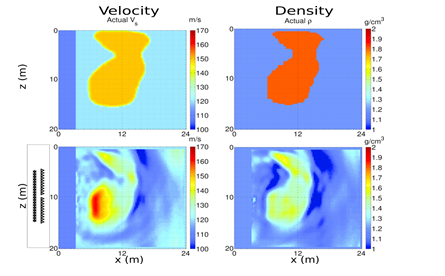
Figure 2. The input model for a karst (top row), with defined seismic velocity and mass density, and the resulting inversion (bottom row) after full waveform inversion of data gathered at the TBM; the black stars and triangles on the left of the bottom row indicate seismic source and receiver positions, respectively.
The seismic NeTTUN team at TU Delft
At the TU Delft, the seismic team consists of the PhD student Pawan Bharadwaj, who is doing most of the work, Prof. Wim Mulder as supervisor and Dr. Guy Drijkoningen as supervisor and project leader.


